Solutions / By the editorial team
Information only, not medical advice or a diagnosis. In a crisis in the US, call or text 988.
The AI Detox Blueprint: Your Gentle Guide to Finding Balance with AI
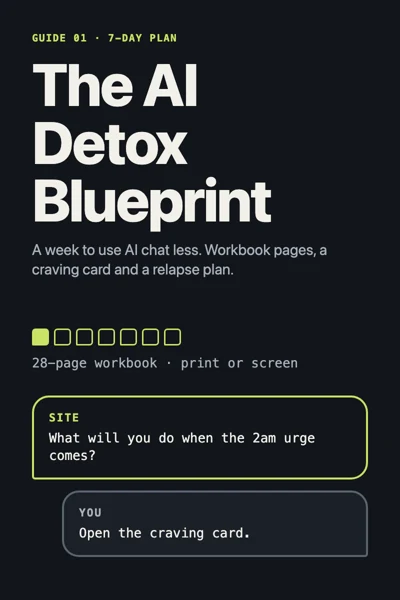
If you have ever felt that you cannot make a decision without asking AI first, this guide is for you. It is a 28-page self-help PDF with a seven-day plan for using AI chat less. It is not treatment, therapy or medical advice, and it does not promise a result.
$9, one payment, instant download. 30-day refund. If it is not useful, ask within 30 days and you get your money back.
Get the Blueprint on GumroadDo You Recognize These Signs?
- Reaching for ChatGPT before trusting your own thoughts
- Feeling anxious when AI tools are not available
- Second-guessing your own abilities since you started using AI
- Finding it hard to decide without AI confirmation
If so, you are far from alone. Heavy, habitual use of AI is common, and wanting a better balance is a reasonable goal. “AI addiction” is not a formal diagnosis. In the DSM-5-TR, gambling disorder is the only recognized behavioral addiction (American Psychiatric Association). The signs above are patterns worth noticing, not a medical condition.
A Gentle 7-Day Reset
This is not a quit-cold-turkey plan. It is a week of small daily steps for noticing how you use AI and deciding how much you want afterward.
What You Get Inside
One PDF of 28 pages, plus a one-page tracker you can print.
- A baseline worksheet, so you can see how much you use the app now
- Seven daily pages: a goal, a morning set-up, the hard moment to expect, something to do instead, and a three-question evening check-in
- A 7-day tracker (minutes, urge from 0 to 10, what happened)
- A trigger log with a worked example
- A one-page craving card you can screenshot
- A relapse plan: what a slip is, a three-step restart, and signs it may be time to ask for help
- Notes for eight apps (Character.AI, PolyBuzz, Zeta, Janitor AI, Chai, Spicy Chat, Replika, ChatGPT). Each says what we could and could not confirm
- A crisis resources page and a plan for weeks two to four
What It Is Not
It is not treatment, and a clinician has not reviewed it. Our editorial team wrote it from published guidance.
We have not tested the Blueprint in a study. We cannot say how it works for any particular person, and we do not publish success rates.
When a Guide Is Not Enough
A PDF cannot replace support from a person. Please talk to a doctor or licensed therapist if your AI use is hurting your sleep, school, work, money or relationships, if you feel hopeless or very anxious, or if you cannot cut back even though you want to.
- Therapist directory: Psychology Today
- FindTreatment.gov, National Helpline 1-800-662-4357
If you are in crisis. Call or text 988 in the US (988 Lifeline), or text HOME to 741741 (Crisis Text Line). In an emergency, call 911.
Is the Blueprint a treatment for AI addiction?
No. It is a self-help guide. AI addiction is not a formal diagnosis, and there is no established treatment program for it.
Do I have to stop using AI?
No. The aim is to use AI on purpose, not by reflex. You decide how much you keep.
What if I feel worse during the week?
Stop and take a break. If you feel sad, panicky or unsafe, talk to someone you trust or a professional. Use the crisis numbers above if you are in danger.
Both guides together: the AI Reset Bundle, $24.
This page is for education only. It is not medical advice, a diagnosis or a treatment plan.