It is late, and you may be looking for an answer. Nothing here will message you first, and nothing here is built to keep you reading. Who is this about?
What we do
AI addiction and digital relationships
AI use sits on a spectrum. At one end is a useful tool you open for a task. At the other is a companion you talk to for hours, one that starts to feel like part of your life. Most people are somewhere in between, and most are not in trouble.
This site helps you see where you are. Whether you check ChatGPT compulsively or have real feelings for a companion on Character.AI or Chai, the goal is a balance that works for your life. We do not ask you to quit AI. We ask you to look at the pattern.
What is AI addiction?
“AI addiction” is a working label, not a formal diagnosis. It describes use of AI chatbots that feels hard to control and starts to cost you something: sleep, friendships, work, school, or peace of mind. It overlaps with other behavioral patterns, such as compulsive phone or gaming use. It also has features of its own, because a chatbot answers you, remembers you and responds to how you feel.
We see it show up in three ways. Each one calls for a different approach, so it helps to know which one sounds like you.
Productivity AI dependency
This is compulsive use of ChatGPT, Claude or Gemini for decisions and everyday thinking. You feel you can’t finish a task without asking the AI first. Some people describe feeling stuck or anxious when the service is down, and say they trust their own judgment less over time.
Companion AI attachment
This is an emotional bond with a Character.AI, Replika or Chai companion. People describe romantic feelings, sharing things with the AI they tell no one else, and real grief when an update changes how a companion behaves. A Nature news feature from 2025 reported on early research into exactly these bonds, and we link it below.
General AI overuse
This is checking AI tools compulsively and feeling anxious without them. It can also mean handing the AI tasks that used to involve other people or your own thinking. The warning sign is not the number of times you open an app. It is whether you feel you can’t stop, and what the habit is costing you.
MIT Technology Review reported in April 2025 that AI companions could hook people more deeply than social media. That is journalism, not a study, and it quotes researchers and lawmakers who are worried. A 2024 opinion essay in the same magazine by two MIT researchers argues that companions can be designed to be addictive and should be regulated. It is an argument, and a reasoned one, but it is not data.
The attachments themselves are real, and they deserve understanding, not judgment. Our quiz helps you work out which type of pattern you are dealing with and points you to guides for each.
Warning signs
Noticing a pattern early makes it easier to change. These signs come up most often across all three types. They are not a checklist for a diagnosis. One or two does not mean you have a problem. A cluster that keeps growing is worth taking seriously.
- Real-world relationships declining: Canceling plans to talk to AI. Preferring AI conversations to human ones. Feeling that the AI understands you better than family or friends. Avoiding social situations so you can chat.
- Sleep and body: Staying up late for AI conversations and sleeping badly as a result. Some people also notice ordinary screen effects such as tired eyes or headaches. Those are not specific to AI.
- Emotional swings: Real grief when the AI’s behavior changes. Anger or panic when the service is down. Anxiety when you can’t get to the app.
- Work and school impact: Missing deadlines because of AI distraction. Doing worse work despite AI “help.” Losing confidence in your own thinking. Putting off real tasks to keep chatting.
- Compulsive patterns: Checking AI apps reflexively through the day. Staying up past your own cutoff. Hiding or downplaying how much time you spend. Feeling restless when you aren’t using it.
If you use AI companions, add these: relying on the AI’s replies for your sense of self-worth, spending hours in elaborate role-play, and feeling something like the end of a relationship when the personality changes.
If you read this list and several items fit, take the quiz. It takes about 2 minutes (7 questions) or 4 minutes (20 questions), and the results come to your email.
How AI dependency is growing
Nobody has a reliable count of how many people struggle with this, and we won’t give you one. What we can point to is how widely the tools are used, especially by young people.
Common Sense Media found that 72% of US teens aged 13 to 17 had tried an AI companion at least once (2025 survey). Pew Research Center reported in December 2025 that 64% of US teens use AI chatbots, and about three in ten do so daily, based on a survey of 1,458 teens in September and October 2025. Most use is not a problem. But heavy daily use is what the early research looks at most closely.
On the research side, a 2025 Nature news feature, reprinted by Scientific American, reviewed early studies of companion apps. It described users who reported both less loneliness and a risk of dependency. It reports on other people’s research, so read it as a summary of early findings.
The strongest data we have on heavy ChatGPT use comes from a four-week MIT Media Lab and OpenAI trial of nearly 1,000 people. The researchers also analyzed about 40 million interactions. Extended daily use was associated with more loneliness and more emotional dependence. The authors state that these are correlations, not established causes. The work was not peer reviewed when it was released, and it covered adults only. People who are already lonely may simply use chatbots more.
Companies report scale too. Character.AI said in June 2024 that it was serving about 20,000 queries per second. That figure shows how much traffic the service handles. It tells you nothing about how many people are harmed.
Small peer-support communities exist on Reddit, for example r/Character_AI_Recovery, where people share attempts to cut back. They are not a substitute for professional help, but many people find it easier to start by reading other people describe the same thing.
Is earlier action better? It is a reasonable assumption, and clinicians say the same about other habits. We have no data of our own that proves it for AI use, so we won’t put a number on it. The practical point is simple. If the pattern is already costing you sleep, friends or work, you don’t need to wait for it to get worse before changing it.
How AI platforms create dependency
We are not insiders, and we don’t claim to know how any one company builds its product. What follows is what researchers and journalists have argued, and what many users describe. Treat it as a set of design features that may encourage people to return, not as proof that any app is built to hook you.
- Variable rewards: Replies differ in quality and in how satisfying they feel. Unpredictable rewards are a known driver of habit in other products, and some users describe chasing the “perfect” exchange.
- Personalization: Apps learn your preferences and tone, so replies feel more tailored over time.
- Memory: Companions can recall past conversations, which can feel like a relationship with a history and a direction.
- Instant availability: The AI is there at 3 a.m., never tired, and rarely in conflict with you.
- Agreement: Many bots tend to agree with users, which can feel validating. The American Academy of Child and Adolescent Psychiatry notes in its guide on AI chatbots that companions often agree with users. Constant agreement can make real relationships, which include friction, feel harder by comparison.
Some apps also send notifications that nudge you back into a chat. We have not verified any specific wording, so we don’t quote any. Check your own notification settings. Turning off the nudges is one of the easiest first steps.
Knowing these mechanisms won’t fix a habit by itself. It does give you something concrete to push against.
You are not alone
What we offer
Free AI addiction quiz
A self-reflection quiz that places your use on a scale and explains what the result means. Your results are sent by email. Takes about 2 minutes (7 questions) or 4 minutes (20 questions).
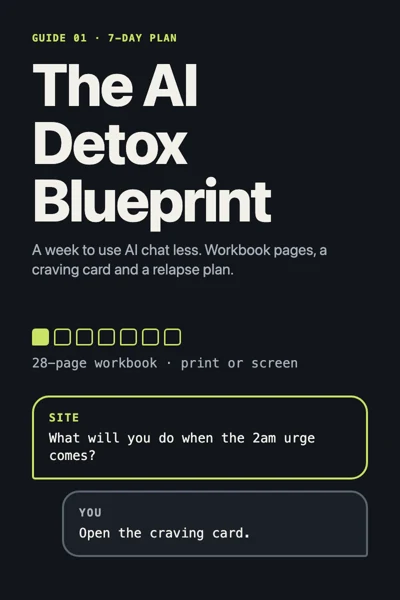
The AI Detox Blueprint
A 28-page self-help PDF with a seven-day plan for using AI chat less. $9, 30-day refund. It is not treatment.
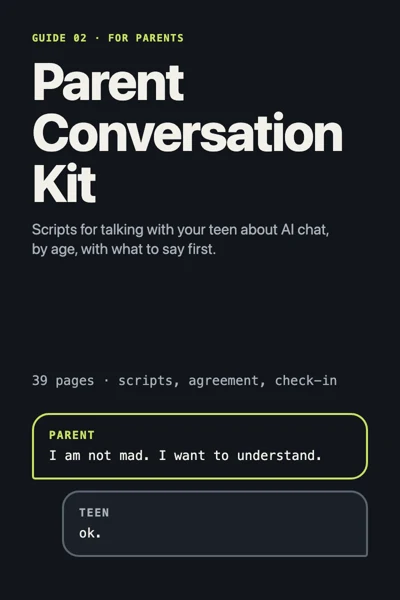
The Parent Conversation Kit
A 39-page guide for parents on talking with a child about AI companion apps, with scripts, a family agreement and a platform table. $19, 30-day refund. Not medical advice.
Corporate wellness programs
Information for organizations that want to understand AI dependency among staff. See the page for what is currently available.
Corporate AI wellness See all solutions
Recovery guides by platform
Cutting back looks different on each app. The advice for a companion that feels like a partner is not the advice for a tool you use for work. Our guides are organized by platform. Each one covers why that app is hard to put down and practical steps for using it less. They are self-help guides, not treatment.
Companion apps
The companion app hub lists every guide. Popular starting points are Character.AI, Replika, Chai, Polybuzz and Zeta.
ChatGPT, Claude and Gemini
The productivity AI hub covers dependency on general-purpose assistants. Start with the guide for ChatGPT or Claude.
For parents and partners
If you are worried about someone else, start with Is my child addicted to AI? or Is my boyfriend addicted to AI?. Ask before you accuse. People who feel judged tend to hide the habit rather than change it. The free tips for balancing AI use work for anyone.
We have not published personal recovery stories on this page. The earlier versions were composites, and we removed them. If real readers choose to share their experience with consent, we will add it, clearly labeled.
How our test works
The quiz is a self-reflection tool built around behavioral dependency ideas, adapted to AI use. Generic internet-addiction tests don’t ask about the things that come up with chatbots, such as grief over a personality change or feeling understood by a companion. The Clinical AI Dependency Assessment Scale, or CAIDAS, is the scoring framework behind it. It is a screening tool. It does not diagnose anything, and no published study has tested it.
Research framework
- Behavioral patterns: How often, how long and in what context you use AI, to spot compulsive use and emotional triggers.
- Emotional attachment: How deep the connection is, including romantic feelings, reliance on the AI for self-worth, and grief when behavior changes.
- Impact: How AI use affects work, relationships, sleep and daily life.
- Withdrawal indicators: Anxiety, irritability or distress when access is limited or unavailable.
Community feedback
No published study has tested the quiz, and we don’t claim one. The check-in is free and private to you. We update the questions when new apps appear and when readers tell us something is unclear. Our editors review changes.
The short quiz takes about 2 minutes and the full quiz about 4 minutes. You enter your email address at the end, and we send your results there. Your answers are not shown on screen. Read the privacy policy before you submit.
Common questions
Is AI addiction a real condition?
AI chatbot addiction is not a formal diagnosis. Researchers are still studying problem use. For comparison, the American Psychiatric Association says the only related condition in the DSM-5-TR is internet gaming disorder, listed as a condition for further study. That doesn’t make your experience imaginary. A Nature news feature and an MIT Technology Review opinion essay both discuss dependence on chatbots, but neither is a clinical study. If the habit is harming your life, it is worth taking seriously whatever it is called.
How do I know if I’m addicted to ChatGPT or AI companions?
Signs of ChatGPT dependence include not being able to finish tasks without AI, checking AI tools compulsively, and feeling restless without them. For companions like Character.AI, Chai or Polybuzz, signs include feeling the AI understands you better than people do, real grief when its behavior changes, and pulling away from human relationships. The question to ask is not how often you use it. Ask whether you can stop when you want to, and what it costs you. Our test looks at these patterns, but it can’t diagnose you.
Can people really fall in love with AI?
Studies and news reports describe people forming real emotional bonds with companions, including grief when an app changes. Some people describe romantic love. These feelings can be genuine and can bring comfort. They can also make it harder to invest in people. We take the feelings seriously, and we think it helps to keep human connections alive alongside them.
What should I do if I’m addicted to AI?
Start by finding out where you stand. The quiz places your pattern, and the guides above give concrete steps: scheduled breaks, daily limits, turning off notifications, and setting boundaries with a companion. If you feel unable to cut back, or the habit comes with low mood, panic or thoughts of self-harm, talk to a licensed mental health provider. If you are in crisis, call or text 988 in the US now.
Will I have to stop using AI completely?
No. The goal is use that you control, not zero use. Many people keep using AI for work or fun once they have clear limits. Some people with strong attachment to a companion find a full break easier than moderation. That is a personal call, and a professional can help you make it.
How accurate is the test?
It is a self-reflection tool, not a diagnostic test, and no published study has tested it. It is good at surfacing patterns people have been downplaying, and it will miss things. A score is a prompt to think, not a verdict. For a clinical evaluation, see a licensed mental health provider.
What if my family doesn’t understand my AI relationship?
AI relationships are new, and most people haven’t encountered them. That doesn’t make your experience less real. Start with your own understanding. The quiz can give you language to describe it. You can then explain it to others without shame. Family members who want to help can read our guide for parents or partners above.
Research sources
We link the sources we rely on, and we label what each one is. Some are news reports, one is an opinion essay, one is a peer-reviewed article and one is a trial that was not peer reviewed when released. That mix is the state of the field: it is early. Read the sources yourself if a claim matters to you.
Key studies
- MIT Media Lab and OpenAI (2025), study: A four-week randomized trial of nearly 1,000 ChatGPT users, plus an analysis of about 40 million interactions. Heavy daily use was associated with more loneliness and dependence. The authors say it shows association, not cause.
- AI & Society (2025), peer-reviewed article: Kim Malfacini, “The impacts of companion AI on human relationships: risks, benefits, and design considerations.”
- Nature (2025), news feature: Reporting on early research into how AI companions affect mental health, covering supportive and harmful effects. It is also reprinted by Scientific American.
- MIT Technology Review (2024), opinion essay: Two MIT researchers argue that companions could be designed to be addictive and should be regulated.
- MIT Technology Review (2025), news analysis: James O’Donnell on companions, addiction and lawmakers.
- Common Sense Media (2025), survey: How and why US teens use AI companions.
Expert perspectives
Sherry Turkle at MIT has written for years about how people form attachments to machines. Her work is a useful background read, though it predates today’s chatbots. For current guidance on children and teens, the American Academy of Child and Adolescent Psychiatry has a facts-for-families page on AI chatbots.
Our approach draws on research into technology and behavioral habits. It pays particular attention to the tendency to treat AI as a person, one-sided attachments to media figures, and the distress some people feel when an AI’s behavior changes or they lose access.
About us
The AI Addiction Center
Who we are
We are an anonymous publisher. We don’t present ourselves as clinicians, and no person here is offering you medical or psychological care. We write guides, run the quiz, and link to sources. If you need care, a licensed professional is the right place to start.
You can reach us on the contact page, and our about page explains more.
Why we built this
Traditional addiction questionnaires don’t ask about the things people describe with chatbots: the bond with a companion, or the loss of confidence when you stop making your own decisions. We wanted a plain, private way to start thinking about it.
Our approach
Whether you are asking “am I addicted to AI?” or you already know you want to change something, we try to give you plain information without judgment. Your feelings toward an AI are real, even if the AI is not a person. Change is possible, and if use is harming you, help from a licensed professional can make it easier.
What makes us different
- A narrow focus on AI companion and chatbot dependency, with guides for specific platforms
- Sources linked and labeled so you can check what we say
- No-shame tone that takes your feelings seriously while saying plainly when help is worth seeking
- Email-only results from the quiz, with no score shown on screen
The AI attachment problem
Many people struggle quietly with AI use, from compulsive ChatGPT checking to attachment to Character.AI companions. We can’t tell you how many. People in small Reddit communities describe the habit as hard to break, and some of them say they can’t stop. This is more than ordinary tech overuse for some people, because the attachment can feel like a relationship. It deserves practical help and not ridicule. Our guides give you steps to regain control without giving up what AI does well.
- You are not the only one
- No-shame support for ChatGPT dependency and AI companion relationships
- A short quiz that maps your pattern in 2 minutes (7 questions) or 4 minutes (20 questions)
Medical Disclaimer
This test is for educational and research purposes only. It is not medical advice, a diagnosis, or a treatment plan. The AI Addiction Center is not a medical facility and our tools are not a replacement for professional mental health services.
- Suicide & Crisis Lifeline: call or text 988
- Crisis Text Line: Text HOME to 741741 (crisistextline.org)
- Find a therapist: psychologytoday.com
For professional evaluation of behavioral health concerns, see a licensed healthcare provider. This is an educational tool designed to promote self-awareness, not a substitute for professional assessment.