For parents / By the editorial team
Information only, not medical advice or a diagnosis. In a crisis in the US, call or text 988.
The Parent Conversation Kit: Talking With Your Child About AI Companion Apps
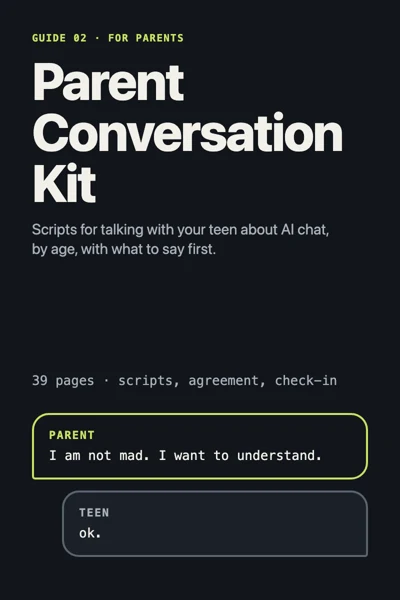
What to say, what to check and what to agree on when your child uses AI companion apps. It is a self-help guide for parents and guardians. It is not medical advice.
$19, one payment, instant download. 30-day refund. If it is not useful, ask within 30 days and you get your money back.
Get the Kit on GumroadWhy parents ask
Apps where people chat with an AI character are common among teenagers. In a July 2025 survey by Common Sense Media, 72% of US teens aged 13 to 17 had used an AI companion at least once (Common Sense Media). In a Pew Research Center survey published in December 2025, about 3 in 10 US teens said they use an AI chatbot every day (Pew). Many parents are unsure how to bring it up. Most use is ordinary. The Kit helps you tell that apart from use worth a conversation.
What you get
- The guide (39 pages): the first ten minutes, what these apps are, how to tell ordinary use from use worth a conversation, what the law and the companies do and do not do, how to start the conversation, setting limits, replacing what the app was doing, when to see a doctor, and what to do in a crisis
- Conversation scripts for ages 12 to 14, 15 to 17 and adult children aged 18 to 24, also as a short 8-page PDF for your phone
- A family AI agreement, printable and editable
- A platform table for twelve apps, with what we could confirm from each company’s own pages and the date we checked. Where we could not confirm something, it says so
- A red-flag checklist and a one-page crisis guide
- A one-page leaflet you can print and share
- A four-week check-in sheet and a school email template
Where the information comes from
Published guidance from the American Academy of Pediatrics, the American Academy of Child and Adolescent Psychiatry and the American Psychological Association. Surveys from Common Sense Media and Pew Research Center. Announcements from the Federal Trade Commission and the State of California. The apps’ own help pages. The guide lists every source with the date we read it. These organizations did not write, review or endorse the Kit.
What the experts do not agree on
AACAP says AI companions are not safe for children and that parents should consider restricting or removing access. The AAP says children and teens can use AI safely and effectively, and that parents should stay engaged. The Kit explains both and does not tell you which to choose.
What it is not
It is not medical advice. Our editorial team wrote it from published guidance. We are not clinicians, and a clinician has not reviewed it. We have not tested it in a study, so we do not know how well it works for any one family. The scripts for younger teens are advice for you, the adult. They are not material for children.
If your child is in immediate danger, call 911. For a mental health crisis, call or text 988 (the 988 Lifeline) or text HOME to 741741 (Crisis Text Line).
Is the Kit medical advice?
No. It is a self-help guide for parents. We are not clinicians, and a clinician has not reviewed it. It does not replace a doctor, counselor or school.
Does the Kit tell me to ban the apps?
No. Experts disagree. AACAP says AI companions are not safe for children and that parents should consider restricting or removing access. The AAP says children and teens can use AI safely and effectively, and that parents should stay engaged. The Kit explains both and does not tell you which to choose.
What if I do not find it useful?
Ask within 30 days and you get your money back.
Both guides together: the AI Reset Bundle, $24.
This page is for education only. It is not medical advice, a diagnosis or a treatment plan.
If you or someone you know is in crisis (US): call or text 988. Text HOME to 741741. SAMHSA 1-800-662-4357. theaiaddictioncenter.com